
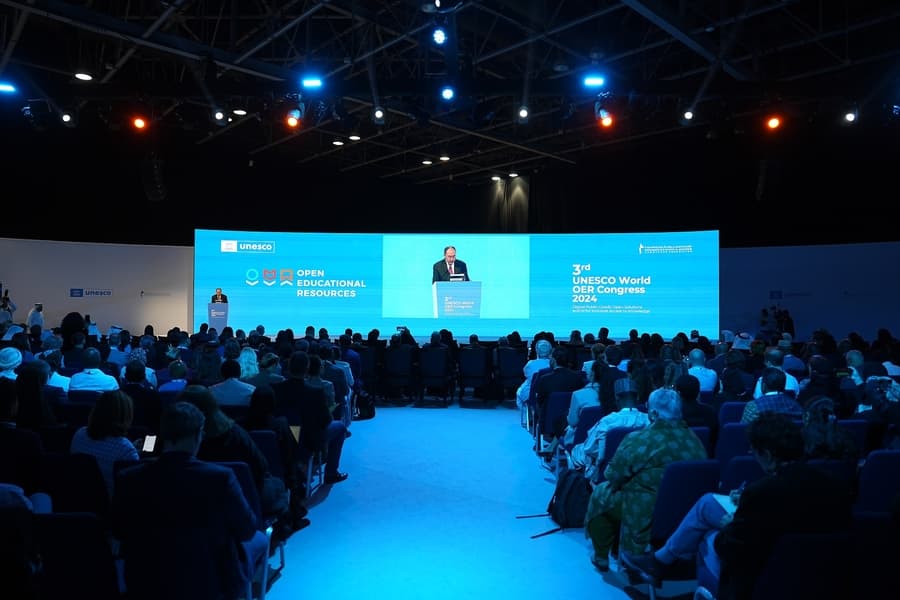
The 3rd UNESCO World Open Educational Resources (OER) Congress, hosted for the first time in the Arab World, kicked off at the Dubai World Trade Centre. Organized by the United Nations Educational, Scientific, and Cultural Organization (UNESCO), in collaboration with the Mohammed bin Rashid Al Maktoum Knowledge Foundation (MBRF), the event convenes global leaders, policymakers, and innovators to explore open solutions and artificial intelligence (AI) for inclusive access to knowledge. Themed 'Digital Public Goods: Open Solutions and AI for Inclusive Access to Knowledge,' the Congress features an agenda packed with high-level panels, breakout sessions, and expert discussions to advance equitable, sustainable education through OER and emerging technologies.
The opening ceremony began with the National Anthem of the UAE, followed by His Excellency Abdul Rahman Al Awar, Minister of Human Resources and Emiratisation and Acting Minister of Higher Education and Scientific Research, delivering a welcome address. Dr Tawfik Jelassi, UNESCO's Assistant Director-General for Communication and Information, delivered an address titled 'Embracing Open Solutions for a Knowledge-Inclusive Future', highlighting the transformative potential of OER in addressing global educational challenges. Several expert discussions were held during the event, including 'Ministerial Panel Shaping the Future of Education', chaired by Louise Haxthausen Director, UNESCO Nairobi. The session also discussed 'Policies for Openly Licensed Learning Content' with the participation of distinguished speakers from Ghana, Burkina Faso, China, Maldives, Cambodia, and Guyana.
During a panel discussion titled 'Harnessing OER and Generative AI for Digital Inclusion', experts delved into the potential of AI and OER to address global challenges, with topics ranging from promoting gender parity in education to leveraging AI for inclusivity. The session was chaired by Dr Colin de la Higuera, Unesco Chair in Open Educational Resources, Université of Nantes, France. The speakers included Dr. Phumzile Mlambo-Ngcuka, Former United Nations Under-Secretary-General and Executive Director of UN Women and Founder of the Umlambo Foundation, South Africa, who highlighted open solutions for achieving gender parity; Seizo Onoe, Director of the Telecommunication Standardization Bureau at the International Telecommunications Union (ITU), who discussed AI's role in standardization for digital inclusion; and Kevin Chan, Director for Global Policy Campaign Strategies at Meta Platforms, Canada, who emphasized the key role of open AI in supporting language inclusion efforts.
Another panel discussion titled 'The Value Proposition for Openly Licensed Learning Content' which was chaired by Dr. Jane Frances Agbu, Advisor Higher Education, Commonwealth of Learning highlighted the innovative applications of OER and shared global best practices. Dr. Tawfik Jelassi, Assistant Director-General for Communication and Information, UNESCO, shed light on the 2019 recommendation for OER's vision for the future; Anna Tumadóttir, CEO of Creative Commons, Iceland, highlighted the role of open licensing in the future of education; Mucktarr M.Y. Darboe, Permanent Secretary from The Gambia, showcased innovative OER applications in Gambia; Tuula Yrjölä, Finland's Ambassador to the Kingdom of Bahrain and the UAE, showcased the Finnish OER Library and its role in implementing openly licensed learning content and Dr Johanna Börsch-Supan, Director General for General Education, Vocational Training and Lifelong Learning, Federal Ministry of Education and Research highlighted the German national OER strategy through video conferencing.
Additionally, two breakout sessions were held during the event on implementing the 2019 Recommendation on OER. The first centered on Action Areas 1 and 2, designed to enhance capacity building and policy development aligned with UNESCO's vision for Open Educational Resources. These sessions provided a platform for in-depth discussions on key issues identified during the 2023 First Consultation of this normative instrument. Emphasizing inclusivity, participants addressed the unique needs of Africa, least developed countries (LDCs), Small Island Developing States (SIDS), youth, indigenous people, and other vulnerable groups. Action Area 1 focused on capacity building to strengthen the foundations of OER initiatives, while Action Area 2 addressed creating and refining policies to support OER adoption and sustainability.
The second breakout session covered Action Areas 3 and 4, which focused on enhancing quality, accessibility, and sustainability in OER. These sessions aimed to address critical challenges and explore innovative solutions in alignment with the priorities identified during the 2023 First Consultation. These discussions highlighted the importance of promoting gender equality and addressing the needs of Africa, least developed countries (LDCs), Small Island Developing States (SIDS), and vulnerable groups such as youth and indigenous communities. Sessions under Action Area 3 emphasized inclusive access to high-quality OER, while Action Area 4 sessions delved into the sustainability of OER initiatives.
The day concluded with a Congress Reception, during which His Excellency Jamal Bin Huwaireb, CEO of the Mohammed Bin Rashid Al Maktoum Knowledge Foundation (MBRF), delivered a welcome address, highlighting Dubai's vital role in advancing global knowledge-sharing and innovation. The Congress will further establish guidelines to promote openly licensed content and tackle challenges arising from AI and other emerging technologies. Discussions will conclude with the Dubai Declaration for Action on OER, outlining concrete steps to advance inclusive and equitable quality education. Many countries have made exceptional progress in implementing UNESCO's OER recommendations, with their initiatives set to be highlighted at the Congress.
For instance, Virtual Health University transformed healthcare education in Cuba by providing flexible, accessible, OER-based learning for professionals, even in remote areas. Furthermore, Madagascar responded exceptionally to COVID-19 challenges by launching an e-learning platform, distributing tablets, and utilizing radio broadcasts to bridge digital divides in primary education. In addition, Malaysia's inclusive OER Policy ensures accessible resources to all, supported by the government for educator training and technology investment. Meanwhile, Morocco's 2024 national OER and Open Science strategy aims to modernize education and expand research accessibility, driven by strong engagement from educators. These initiatives showcase diverse approaches to advancing equitable access to knowledge through OER across different contexts. The Congress aligns with the objectives of Knowledge Summit, which has positioned itself as a leading global event for the exchange of knowledge, expertise, and success stories.