
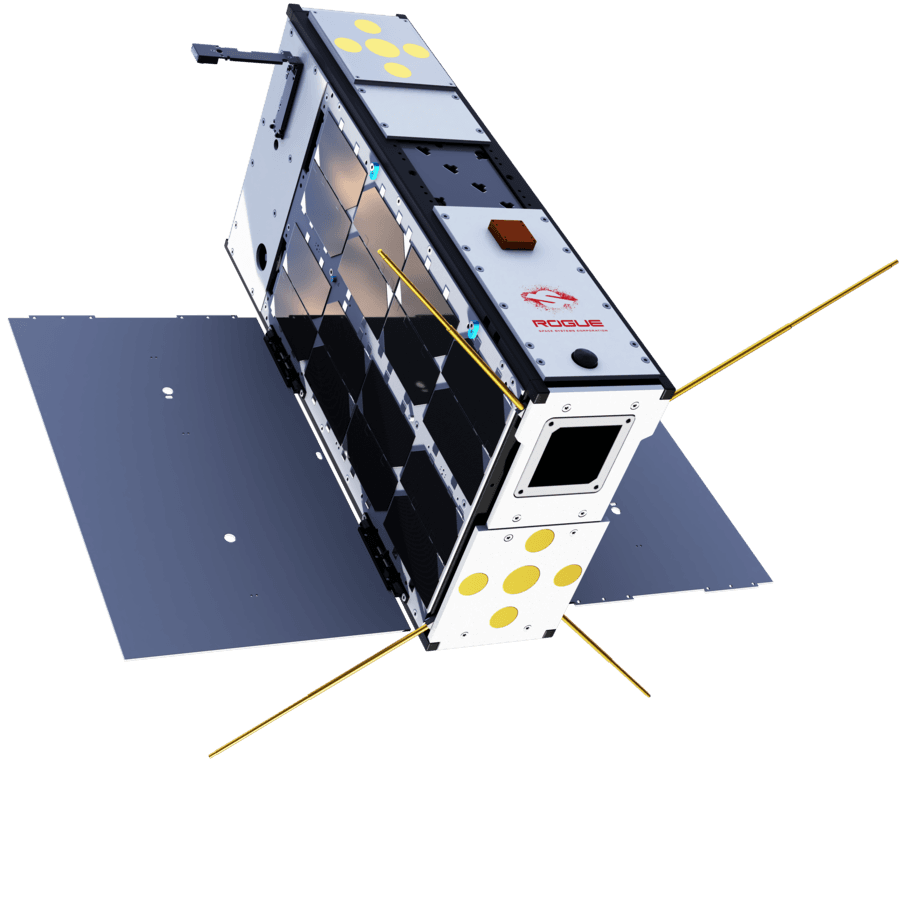
Rogue Space Systems Corporation announces its OTP-2 mission featuring new capabilities and commercial hosted payloads, with launch planned for no earlier than February 2025. The primary objective involves testing mission operations and algorithms for future in-space logistics services requiring close-proximity maneuvering and docking. The spacecraft will carry one undisclosed payload, a new propulsion system, encryption technology, edge computing device, and five optical sensors alongside the standard star tracker.
The mission will demonstrate Rogue's next-generation Scalable Compute Platform (SCP) providing critical computer vision, autonomy, and artificial intelligence computations through edge computing. The SCP serves as a testbed for algorithms supporting future rendezvous, proximity operations, and docking (RPOD) operations, including the new ASTRA autonomy system designed to autonomously maintain spacecraft health and execute operational goals. Rogue is also offering commercial software hosting on the SCP, allowing customers to test algorithms in space with support from a ground test bench at Rogue headquarters to confirm suitability before upload.
OTP-2 will feature five cameras interfacing directly with the SCP and will serve as a cooperative target for the subsequent OTP-3 mission planned for 2026. The mission includes three hosted payloads from emerging space technology companies. Forward Edge AI will demonstrate its Isidore Quantum® Space Encryptor providing protocol-free quantum-resistant encryption in a compact form factor, available at their product page. IVO Limited will test its revolutionary Quantum Drive, representing the world's first propellant-free pure electric propulsion system, with details at their website.
This mission represents a foundational step toward providing in-space logistics services and establishing credibility as a reliable space service provider. The technologies demonstrated on OTP-2, including autonomous operations, quantum-resistant encryption, and innovative propulsion systems, address critical challenges in space infrastructure development. These capabilities enable more sustainable and efficient space operations, reducing dependency on ground control and enhancing security against emerging threats such as quantum computing attacks on encryption systems.
The implications extend beyond immediate mission success to enabling future commercial space activities including on-orbit servicing, refueling, and manufacturing. By demonstrating autonomous decision-making and close-proximity operations, Rogue advances toward creating a dynamic space economy where spacecraft can independently manage complex tasks and interact safely with other assets. Customers interested in future opportunities may participate in the OTP-3 mission planned for 2026, which will feature enhanced maneuvering capabilities and docking systems for refueling operations.