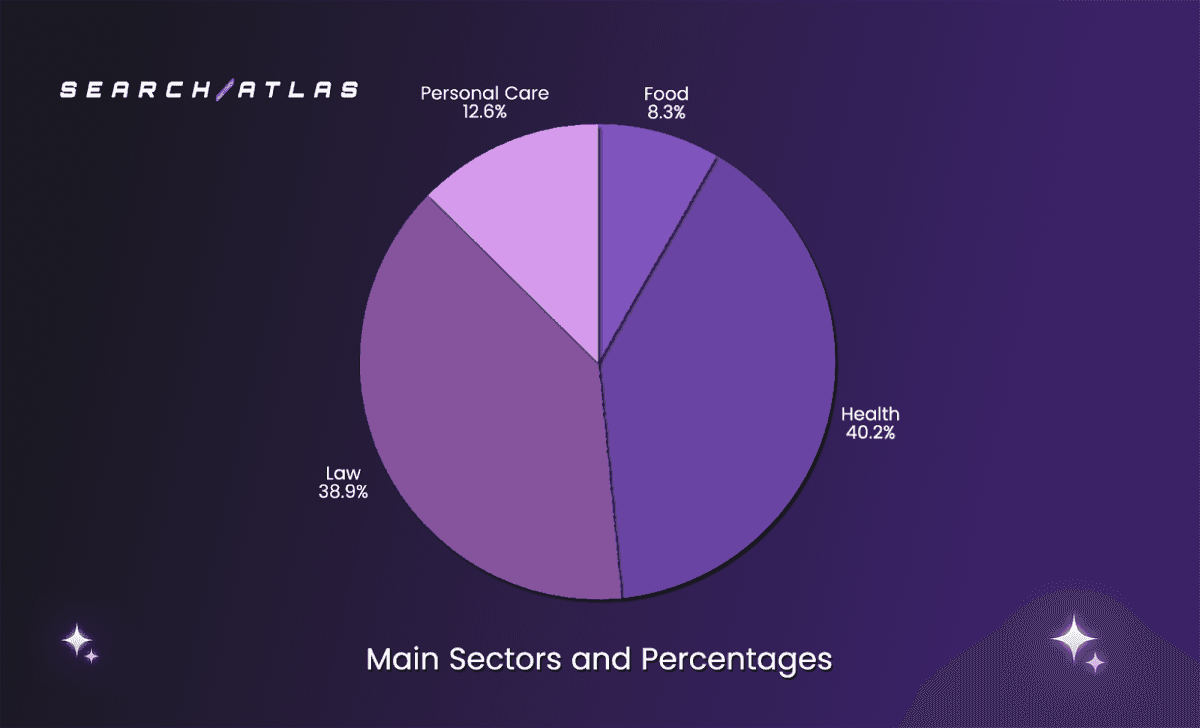
New research from Search Atlas provides definitive quantification of Google Business Profile ranking factors, revealing that proximity accounts for approximately 48% of ranking influence across all sectors, making it the single most important factor in local search visibility. The study analyzed 3,269 local businesses across food, health, law, and beauty sectors, using machine learning techniques to measure how various factors contribute to ranking outcomes in Google's local map pack.
The global analysis shows that industry type follows proximity at 21% influence, while review keywords contribute 11% and the number of reviews accounts for 8% of ranking power. Business name matching with search queries provides a 7% advantage, while profile and website optimization combined contribute only 2-3% to overall rankings. Ratings, business category relevance, and website authority play minimal roles at less than 1% each, indicating that technical SEO factors are substantially less important than location and customer feedback signals.
Sector-specific findings reveal important variations in ranking dynamics. In the food sector, proximity remains dominant at 46%, but review keyword relevance (19%) and equal contributions from ratings and review count (15% each) create competitive differentiation. For top 1-5 rankings in food, review count increases to 23% importance while proximity drops to 41%, showing that elite positions require both location advantage and strong review performance.
The health sector demonstrates unique characteristics where category relevance becomes particularly influential at 18%, reflecting the importance of accurate service classification for medical providers. In top health rankings, proximity drops to 24% while review volume and relevance become equally important at 23% and 22% respectively, indicating that credibility signals gain weight for premium positions in trust-sensitive industries.
Legal services show the strongest proximity dependence at 68% influence for positions 1-21, underscoring how location-critical legal counsel searches are for users seeking nearby representation. However, for top 1-5 law firm rankings, review relevance grows to 22% and review count to 17%, demonstrating that even in proximity-dominated sectors, review quality becomes crucial for achieving the highest visibility.
The beauty and personal care sector presents the most dramatic shift from proximity dependence, with reviews driving almost half of ranking influence at 48% while proximity matters less at 21%. For top beauty rankings, review count leads at 35% and business name-keyword match becomes critically important at 30%, while proximity drops to just 13%, showing that reputation and branding substantially outweigh location factors in aesthetic services.
The research methodology employed XGBoost regression machine learning to analyze data from keyword-based SERP grid visibility, business profile metadata, and website content with reviews. The model explained 75% of the variance in GBP rankings, providing strong predictive accuracy for structured local search signals. This quantitative approach moves beyond industry anecdote to deliver measurable percentages for each ranking factor, enabling businesses to prioritize efforts based on empirical evidence rather than speculation.
Practical implications for businesses include treating proximity as a fixed baseline factor rather than a competitive differentiator, developing review strategies that encourage service-specific keywords in customer feedback, aligning business names with keyword intent to improve natural language processing matching, and applying sector-specific optimization approaches that reflect the unique weighting patterns of each industry. The study confirms that Google applies natural language processing to extract meaning from customer reviews, website metadata, and backlink anchors, making semantic alignment with search intent increasingly important for local visibility.