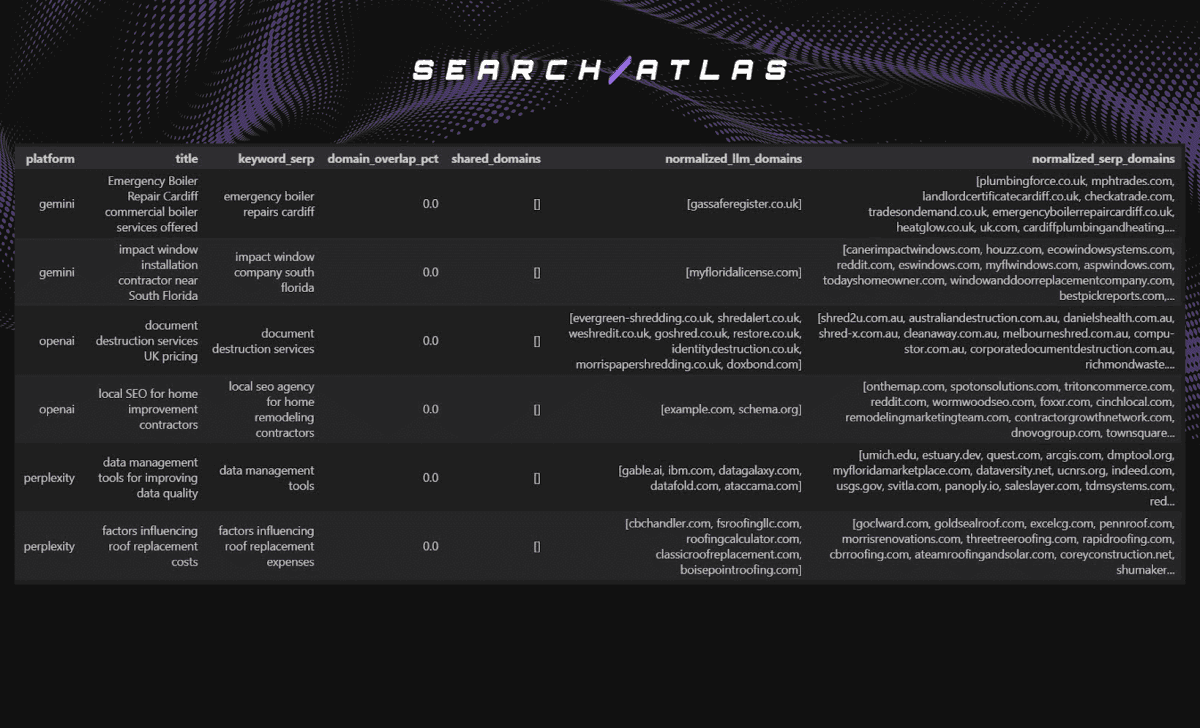
A new study analyzing 18,377 semantically matched query pairs reveals that AI-generated answers cite fundamentally different web sources than those appearing in search engine results pages, creating urgent implications for brand visibility in the emerging Generative Engine Optimization landscape. The research provides the first large-scale empirical analysis of LLM-SERP alignment, measuring exact overlap between AI-cited sources and Google-ranked domains across informational, navigational, transactional, evaluation, and understanding query types.
The study analyzed three leading AI platforms—Perplexity, OpenAI's ChatGPT, and Google's Gemini—revealing dramatic differences in how each system aligns with Google Search results. Perplexity demonstrated the highest search alignment with 43% domain overlap with Google Search results and 24% URL overlap representing exact page matches. ChatGPT showed significant divergence with only 21% domain overlap and merely 7% URL overlap, confirming minimal direct source matching. Google Gemini exhibited selective precision with 28% domain overlap despite being Google-developed and only 6% URL overlap, favoring curated high-confidence sources.
A critical finding emerged in the gap between domain-level and URL-level overlap, revealing how AI systems understand and reference web content. Domain overlap averaged 21-43% depending on platform, while URL overlap remained below 10% for reasoning-based models. This domain-URL gap confirms AI systems understand topics similarly to Google but synthesize from broader knowledge rather than directly retrieving ranked pages. The distinction is crucial for SEO strategy according to researchers, as domain overlap shows that AI models and Google discuss the same subjects and recognize similar authorities, but low URL overlap proves that ranking on page one of Google doesn't guarantee citation in ChatGPT responses.
Query intent significantly impacts AI-search alignment patterns across five categories. Informational queries showed moderate overlap, with Perplexity achieving 30-35% consistency while ChatGPT remained below 15%. Navigational queries demonstrated similar patterns, with retrieval systems maintaining stronger alignment to official sources. Transactional queries revealed the widest variance, as AI systems often synthesize recommendations rather than citing specific merchant pages. Evaluation queries showed moderate overlap, with reasoning models creating original comparative frameworks rather than citing review aggregators. Understanding queries achieved the highest Gemini performance, where its selective precision approach excelled at identifying authoritative educational sources.
The divergence between AI-cited sources and Google-ranked results creates an urgent need for expanded SEO metrics that measure brand presence across both traditional search and AI-generated answers. SEO teams can no longer measure success solely through Google rankings, organic traffic, and keyword positions. LLM Visibility—tracking how often your brand appears in AI-generated responses, how it's represented, and which competitive context surrounds it—is now equally critical. The study identified specific content attributes that improve citation rates across both search engines and large language models including semantic precision, structured data implementation, authoritative domain signals, content freshness, and factual accuracy.
The convergence point between SEO and AI optimization centers on semantic clarity according to researchers. Content that helps search engines understand your expertise also helps language models identify you as a credible source. But the execution differs—traditional SEO emphasizes links and rankings, while AI visibility requires becoming the definitive answer to specific questions within your domain. The research methodology analyzed data collected between September and October 2025, examining responses from OpenAI (ChatGPT), Perplexity, and Google Gemini alongside corresponding Google Search results. Researchers employed an 82% cosine similarity threshold to identify semantically equivalent queries, ensuring linguistic resemblance while allowing for natural query variation.