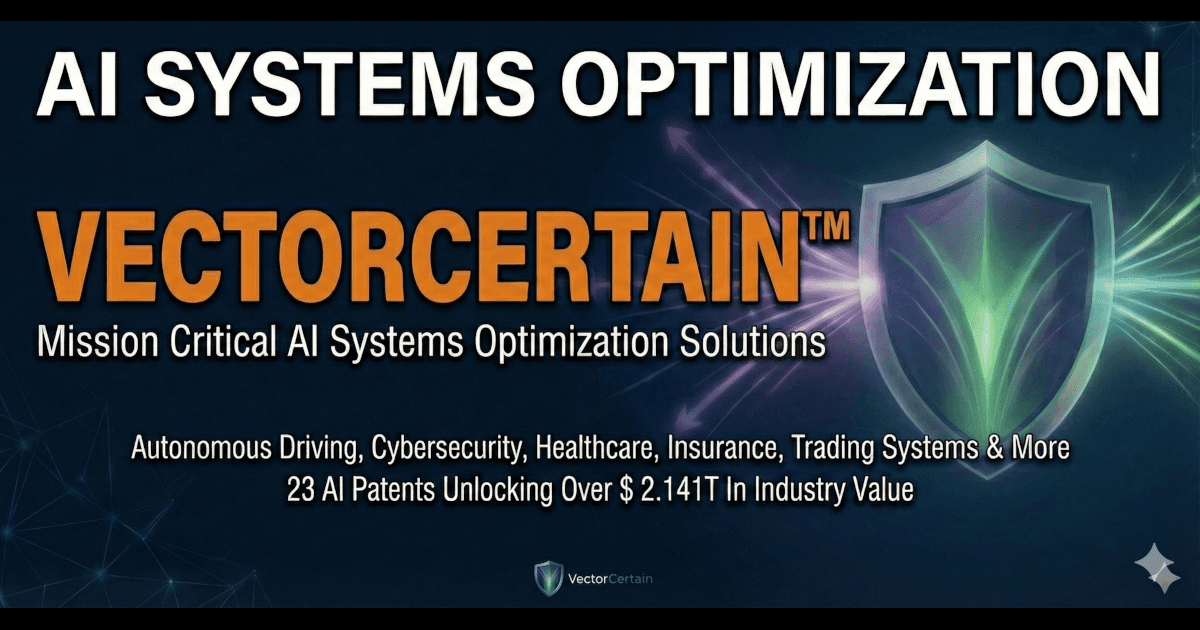
VectorCertain LLC today disclosed its comprehensive 55-patent intellectual property portfolio, the first AI safety architecture built on a governance-first, permission-to-act paradigm that spans autonomous vehicles, cybersecurity, healthcare, financial services, blockchain/DeFi, energy infrastructure, manufacturing, satellite systems, content moderation, and government AI certification. Of the 55 patents in the ecosystem, 21 have been filed with the remaining 18 in active development and scheduled for filing through 2026. The portfolio encompasses over 500 claims, with every filed application scoring 10.0/10 on independent quality assurance review.
Unlike bolt-on safety layers or post-hoc auditing frameworks, VectorCertain’s patents are architected from the ground up around a single principle: AI must earn permission to act, every time, through mathematically verifiable independent governance. This paradigm replaces model-centric safety, optimization-centric AI, and retrospective validation with governance-first, permission-to-act safety. The portfolio is organized in a three-layer hub-and-spoke architecture where authority flows from governance hubs down through application spokes, ensuring that no application ever redefines safety—it only applies governance defined at the hub level.
The architecture natively addresses 47+ regulatory frameworks across industries, with compliance not as a periodic audit function but as a continuous, real-time property of the system’s operation. Every inference generates auditable compliance evidence automatically, with comprehensive recording of all mission-critical events. Regulatory frameworks addressed include ISO 26262 for autonomous vehicles, FDA 21 CFR Part 11 for healthcare, OCC SR 11-7 for financial services, NIST Cybersecurity Framework, EU AI Act, and many others detailed at https://www.vectorcertain.com.
VectorCertain validated its technology against more than 50 catastrophic failures spanning 2000–2024 across 11 industries. By applying the patent-pending permission-to-act architecture to historical failure data, VectorCertain demonstrated that $1.777 trillion in losses were preventable. This back-casting methodology provides concrete, verifiable evidence that governance-first AI safety addresses real-world failures. Specific prevented loss estimates include $476 billion in autonomous vehicle losses, $557 billion in financial fraud, $300 billion in manufacturing quality control failures, $93 billion in energy grid systems, $54 billion in regulatory compliance losses, $25 billion in financial trading, and $20 billion in cybersecurity incidents.
Analysis of 1,600+ AI governance patents from IBM, 5,000+ AI patents from automotive OEMs, 1,100+ AI patent families from Siemens Healthineers, and comprehensive searches across Google/DeepMind, Microsoft, and NVIDIA portfolios reveals consistent gaps where VectorCertain’s governance-first ensemble claims are novel. The hub-and-spoke structure provides patent defensibility, licensing flexibility, and future-proofing, enabling industry-specific licensing bundles and allowing new application spokes to be added without modifying core hub patents.
Key technical specifications include the MRM-CFS (Micro-Recursive Model Cascading Fusion System) with individual models as small as 29–71 bytes, total memory footprint under 50 KB for a full autonomous driving ensemble, inference latency under 1 ms, and tail-event accuracy over 99%. The GD-CSR (Graceful Degradation Through Combinatorial Sensor Redundancy) provides a mathematically proven no-blind-spot guarantee under sensor failure. The architecture targets the highest safety certifications across industries: ASIL-D for automotive, IEC 62304 Class C for medical, DO-178C DAL-A for aerospace, and more.
The addressable market for safety-critical AI is estimated at $157–240 billion by 2030. VectorCertain’s core paradigm—that AI systems do not self-authorize—represents a fundamental shift from reactive safety to proactive governance, preventing failures through mathematical verification before execution. The company’s 55-patent ecosystem provides the governance layer that determines when artificial intelligence may be trusted, relied upon, or allowed to act across physical, digital, human, and adversarial domains.