
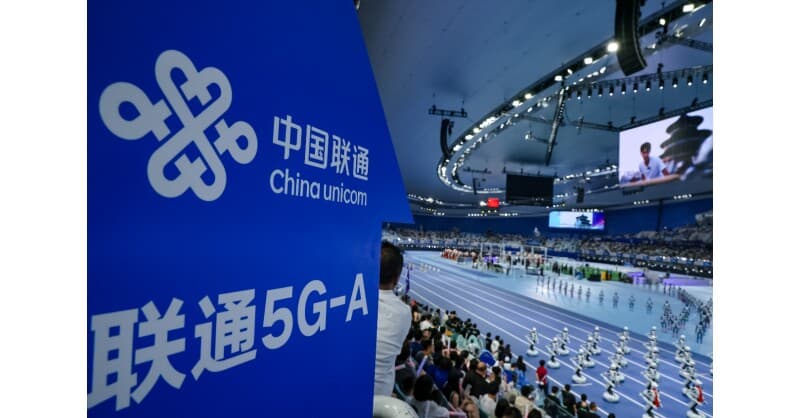
The 2nd World Humanoid Robot Games, held at Beijing's National Speed Skating Oval, showcased not only the prowess of humanoid robots but also the critical role of advanced network infrastructure in enabling their performance. The event, which opened yesterday, featured 2,056 robots from 666 teams competing in 51 events, nearly double the number from the inaugural Games. The increased complexity and autonomy of competitions demanded network capabilities far beyond conventional standards.
To meet these challenges, China Unicom Beijing and Huawei deployed a dedicated 100 MHz network complemented by a 300 MHz LampSite ultra-wideband indoor system. This setup supports real-time telemetry and precise signaling, ensuring that robots can operate with millisecond-level responsiveness. A dedicated 5QI 7 slice with carrier isolation keeps end-to-end latency within 30 milliseconds, critical for coordinated movements and obstacle avoidance. Furthermore, integrating the network with BeiDou RTK positioning provides decimeter-level accuracy, essential for autonomous navigation and precision racing.
The network's performance was validated with peak uplink speeds of 1 Gbps and average latency below 30 milliseconds. This high-capacity uplink is vital for transmitting vast amounts of sensor data and control signals simultaneously from multiple robots, enabling complex interactions such as table tennis and kickboxing competitions.
Beyond the robots, the network also prioritized spectator experience. Dynamic adjustment of network resources and service assurance policies during different phases of the event ensured stable access to essential services like instant messaging, ticket inquiries, and mobile payments, even in high-density crowds. This allowed spectators to share their experiences in real time without connectivity issues.
China Unicom also introduced the country's first embodied AI robot management platform designed for event scenarios. By assigning unique network IDs to each robot, staff can monitor their location, competition status, and operational metrics in real time, creating a closed-loop management system that enhances operational efficiency.
The significance of this deployment extends beyond the Games. Yang Lifan, Deputy General Manager of China Unicom Beijing, emphasized that this real-world test will help accumulate valuable network assurance experience for the large-scale deployment of embodied AI. He noted, "China Unicom will continue to build on the experience gained through the 5G Capital initiative and turn technological innovation into tangible and replicable network capabilities for the Mobile AI era."
David Li, President of Huawei's Wireless TDD Product Line, echoed this sentiment, stating that the Games provided a compelling validation of the 5G-A 100 MHz GigaUplink network based on 3.5 GHz 2CC + 2.1 GHz SUL for embodied AI scenarios. He added that Huawei will continue to work with China Unicom Beijing to strengthen uplink capabilities and advance spectrum coordination, building multidimensional network capabilities for multimodal device-to-cloud transmission.
This network infrastructure is a cornerstone of the 5G Capital initiative, which aims to provide ubiquitous, secure, and reliable connectivity across Beijing for cultural tourism, embodied AI, and Mobile AI applications. The successful deployment at the Games demonstrates the potential for such networks to support humanoid robots in real-world settings beyond the arena, from industrial production to homes and logistics. As embodied AI becomes more prevalent, the connectivity foundation laid here will be crucial for enabling real-time interaction and precise control, ultimately helping to integrate intelligent robots into everyday life.
