
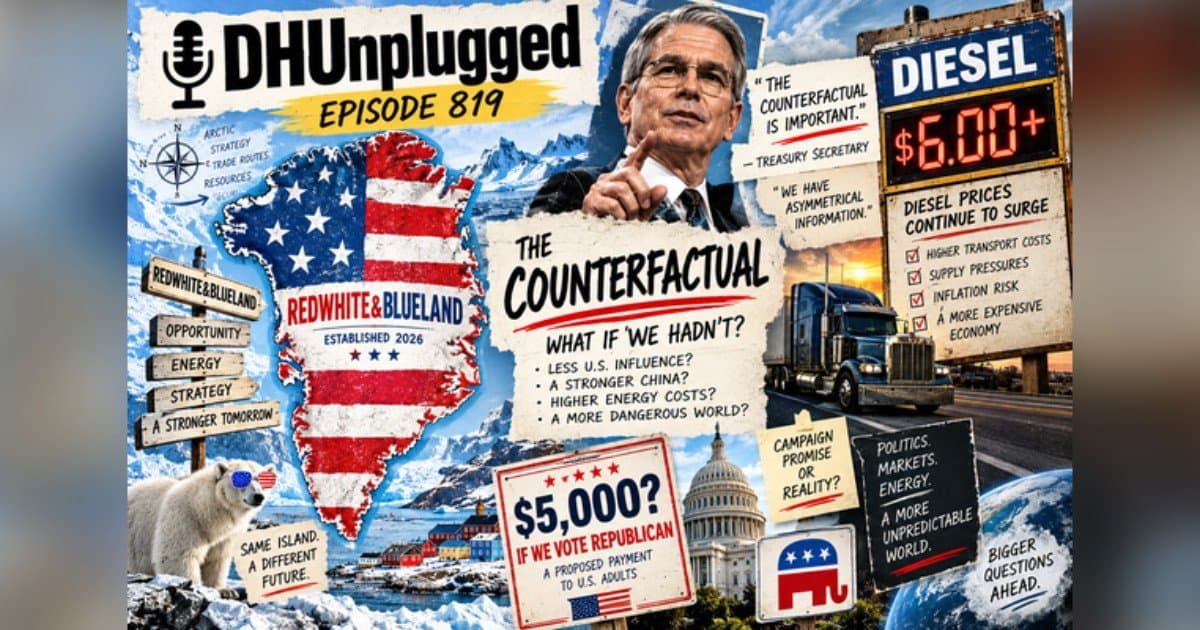
Treasury Secretary Scott Bessent's recent testimony before the House Financial Services Committee has ignited a debate over the use of unfalsifiable claims in economic policy. In a now-viral exchange with Representative Jim Himes on September 15, Bessent defended the government's bond-buying program by asserting, "there's a counterfactual of what it would have done." This rhetorical maneuver, dissected in episode 819 of DH Unplugged, raises critical questions about how officials justify interventions that lack empirical grounding. Host Andrew Horowitz, a registered investment advisor, warns that such statements create a "non-provable element" that "dilutes the reality of what's going on so that you don't know what's happening." Co-host John C. Dvorak, drawing on his background in causal analysis, notes that legitimate counterfactuals require a control group, historical analog, or synthetic comparison—not mere assertion. The implications are profound: if policymakers can shield their decisions behind unverifiable claims, public oversight and market accountability erode, leaving investors and citizens unable to assess the true impact of government actions.
The episode, recorded on Dvorak's birthday, also examines other market-moving developments that underscore a week of policy skepticism. SoftBank and its founder Masayoshi Son are borrowing roughly $11 billion at junk-bond rates to fund ChatGPT-related investments, a move that signals both the enormous capital demands of artificial intelligence and the risks of leveraging high-yield debt for speculative ventures. Meanwhile, Warren Buffett's decision to step down as Berkshire Hathaway chair, with Howard Buffett taking the seat and Greg Abel running operations, marks a historic transition for one of the world's most closely watched conglomerates. Additionally, Meta's Ray-Ban Luxottica smart glasses are facing a Paris prosecutor probe over covert filming, highlighting growing regulatory scrutiny of tech products that blur the line between convenience and privacy invasion.
Horowitz and Dvorak also delve into the technical underpinnings of market indices. They contrast the market-cap-weighted S&P 500 with the equal-weighted RSP ETF and the price-weighted Dow Jones Industrial Average, where a single dollar move in Caterpillar translates to roughly seven Dow points. This primer serves as a reminder that index movements can be misleading, especially when a narrow band of names drives NASDAQ 100 highs. The hosts revisit their long-running Generac (GNRC) seasonality trade, now transformed by data-center power demand, and name Seagate, Western Digital, and Micron among 2026's stealth outperformers. They also flag Greenland-linked equities Greenland Minerals (GRML) and Critical Metals (CRML) surging on Trump's expanded Danish security deal, and question Bentley's $300,000 electric SUV as a Porsche-style luxury-to-premium downgrade.
For investors, the throughline is clear: in an environment where officials can invoke counterfactuals and markets are swayed by narrow leadership and speculative debt, skepticism is a necessary tool. The episode reinforces that understanding the mechanics behind policy claims and market moves is essential to navigating the noise.