
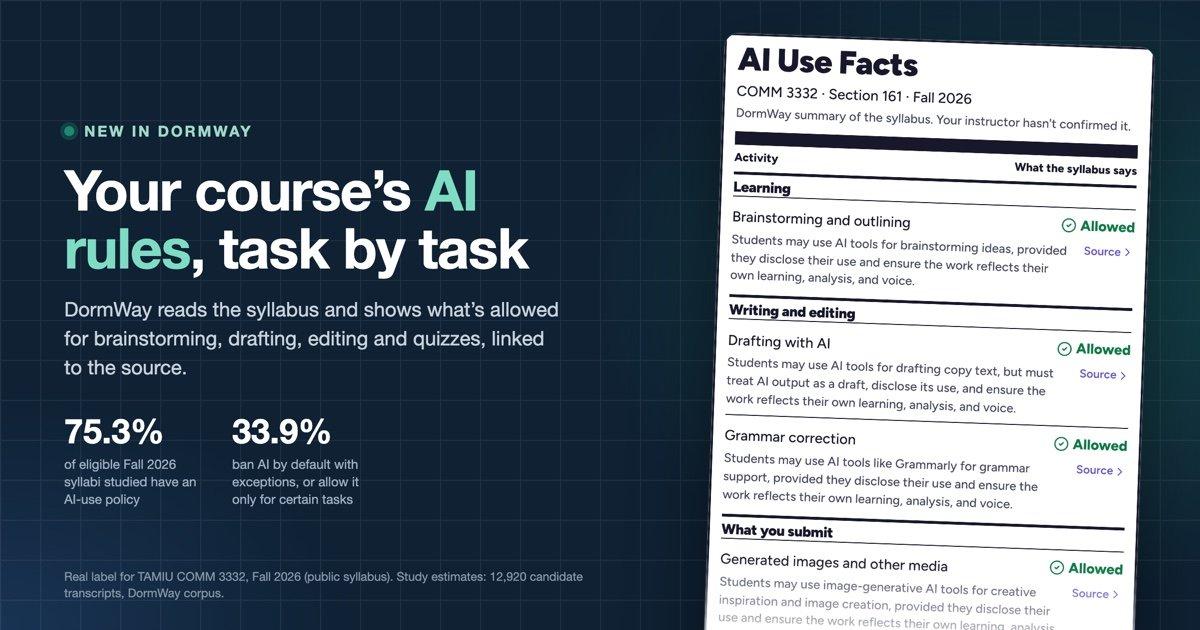
Students often face conflicting AI rules across their courses, with one class permitting AI on exams while another prohibits it for brainstorming. DormWay, a student planner that consolidates syllabus deadlines, class schedules, and course policies, has analyzed these inconsistencies and introduced a Course AI Use Label to help students understand what each course requires. The label provides a short, consistent summary of whether AI is permitted for studying, brainstorming, editing, submitted work, and exams, along with approval and disclosure requirements.
The need for clarity is pressing: according to LinkedIn's 2026 report, U.S. jobs requiring AI literacy grew 70% year over year. As employers increasingly seek AI skills, students must not only prepare for workplaces where responsible AI use is part of the job but also meet each instructor's expectations. DormWay's label addresses this by automatically reading a syllabus's AI rules and displaying them on the course page, linked to the source syllabus. The label is an automated summary; the instructor's instructions remain authoritative. A free downloadable template lets faculty and students fill in the same label by hand, and instructors choose the rules that fit their courses.
DormWay's analysis of 12,920 candidate Fall 2026 syllabus transcripts, checked against a random source-review sample, estimates that 75.3% of eligible, policy-evaluable documents contain an operative AI-use policy. An estimated 33.9% use default prohibitions with exceptions or limit permission to specific tasks or assessments, while 11.7% contain mixed or unclear permission rules.
Official public Fall 2026 syllabi illustrate the range of decisions. Texas A&M International University's ENGL 3307 prohibits AI throughout its creative-writing process, including brainstorming and editing, while COMM 3332 encourages AI-assisted ideas, draft copy, and imagery under attribution and verification rules but prohibits quiz use and direct pasting of AI-generated body copy. At UT Austin, CS 380I permits programming assistance while requiring students to understand and explain submissions, and its exams permit AI with disclosure of tools and affected questions; CS 439 treats generated code or text solutions as unauthorized unless explicitly permitted in writing. Even within a single syllabus, students may need to reconcile an allowance with a broader warning, as UT Austin's introductory CS 109 describes instructor-authorized AI use alongside general integrity restrictions on AI-generated assignments. Acknowledging a tool does not override a prohibition or replace advance approval, and consequences can be substantial: TAMIU's ACC 4370 specifies a course F and Honor Council referral for breaching its assessed-work AI restrictions.
"Students should be able to find the rules before they start an assignment. A consistent label makes those expectations easier to check and helps students understand where responsible AI practice fits into their education. Instructors would continue to decide which uses support their teaching," said Riley Crimmins, CEO and co-founder of DormWay.
The label uses task-level entries for studying, brainstorming, editing, generated submissions, and exams, with conditions for approval and disclosure, permitted tools, and a dated source. Missing information remains "not specified"; a label does not create permission. A companion seven-question checklist helps students verify instructions. These findings reflect DormWay's filtered transcript collection, not national college policy or student outcomes. The overview, research note, label template and student checklist provide confidence intervals, validation details, limitations, and links to the official course examples. DormWay's core organization tools are free at dormway.app.