
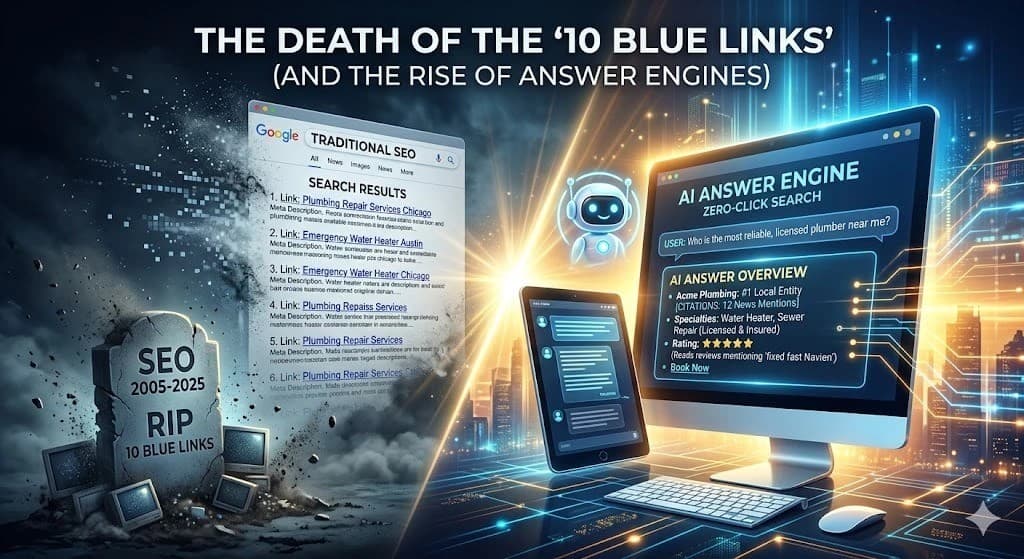
A new guide released by Demand & Convert, LLC, titled 'The 2026 Guide to AI Search for Plumbers: How to Rank in ChatGPT, Perplexity, and Google AIO,' signals a fundamental shift in how homeowners find plumbing services. The report argues that the traditional model of competing for Google's first page has been disrupted by AI Answer Engines that provide a single definitive recommendation rather than a list of links.
According to the guide, homeowners facing emergencies like pipe bursts or high-ticket sewer repairs are increasingly turning to ChatGPT, Perplexity, and Google's AI Overviews with queries such as, 'Who is the most reliable, licensed plumber near me?' This change represents what Demand & Convert calls the 'Zero-Click Reality,' where consumers receive an answer without clicking through to a website. For plumbing companies still relying on 2020 SEO tactics like keyword stuffing and generic backlinks, the result is growing invisibility in the engines that dictate consumer choice.
'If a plumbing company is still relying on 2020 SEO tactics... they are rapidly becoming invisible to the engines that dictate consumer choice today,' said Chin Rath, Co-Founder at Demand & Convert. 'This isn't a future prediction; this is a zero-click reality happening right now. Companies that aren't engineered for AI visibility are handing high-ticket jobs directly to their competitors.'
The guide is designed for plumbing company owners generating between $1 million and $10 million in annual revenue, as well as franchise marketing directors. It details a technical transition from traditional Local SEO to what Demand & Convert terms 'Entity Trust Engineering.' Key strategies include understanding how Large Language Models use Retrieval-Augmented Generation (RAG) to read local news and community forums like Nextdoor to assess a plumber's true reputation, bypassing generic five-star review counts.
Another critical component is the '3-Step Photo Optimization Protocol,' which emphasizes that raw smartphone photos no longer suffice; geo-tagged EXIF data is now mandatory for AI local verification. The guide also advocates for an 'Answer-First' content strategy, declaring generic blogs like 'How to unclog a drain' obsolete. Instead, publishing proprietary, hyper-local pricing data is presented as the only way to feed the Knowledge Graph. Finally, the guide outlines how to design a frictionless user experience that instantly validates an AI's recommendation when a user clicks through to a website.
The implications of this shift are significant. As Rath notes, 'The plumbing companies that adapt to LLM optimization and advanced schema markup today are building an insurmountable digital moat. Because AI models train on historical data and established trust, the companies that become the AI's preferred recommendation in 2026 will be nearly impossible to unseat in 2028.'
Plumbing business owners, general contractors, and marketing professionals can access the complete diagnostic blueprint for free at demandconvert.com.