
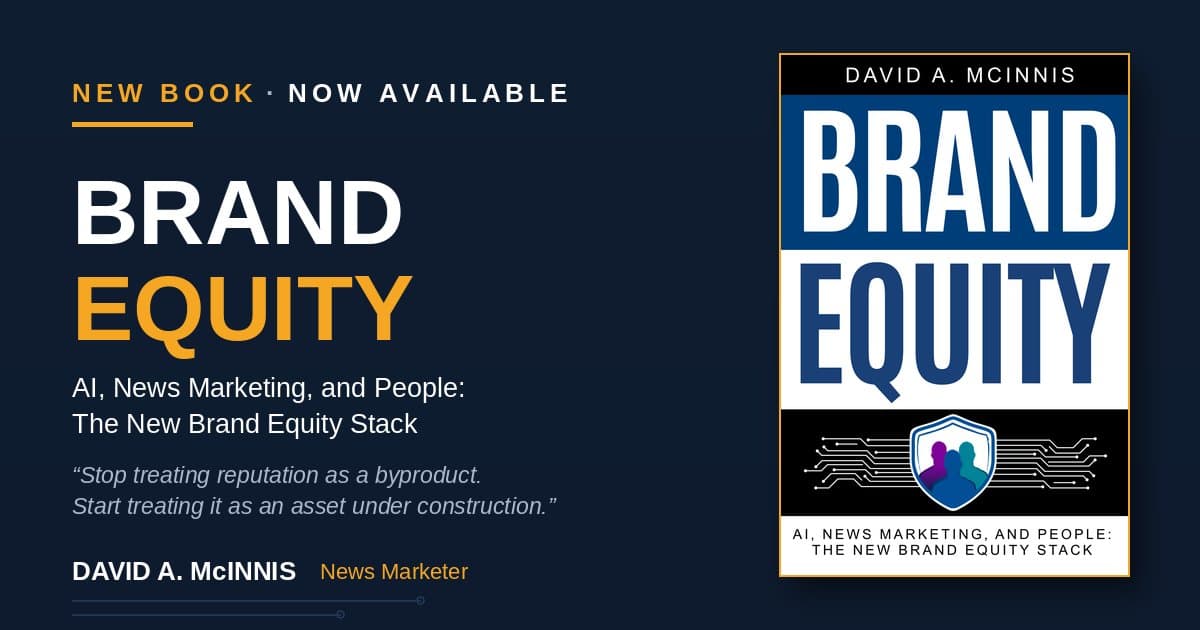
David A. McInnis, the entrepreneur widely credited with pioneering News Marketing and founder of PRWeb, has released his latest book, Brand Equity: AI, News Marketing, and People: The New Brand Equity Stack. The book, which serves as the second installment in a series that began with News Marketing, contends that brand equity is no longer solely what consumers remember, but also what AI and search systems can find, trust, and reuse when someone asks a question in a company's category. McInnis defines brand equity as the accumulated trust, recognition, and preference that resides in people's minds, translating into tangible commercial advantages like higher prices, faster conversions, and increased resilience to mistakes.
For decades, McInnis notes, building brand equity seemed reserved for corporations with massive television budgets and dedicated research teams. However, the transformation of distribution, measurement, and discovery has leveled the playing field. Small and mid-sized businesses can now intentionally build equity and demonstrate its growth without requiring an eight-figure media spend. The book's central framework is what McInnis calls the 'new brand equity stack,' comprising AI, News Marketing, and people. AI accelerates research and content creation, while people and culture ensure the brand's authenticity at every touchpoint. In the middle, News Marketing serves as the engine for credibility and findability.
McInnis explains that "AI makes the process faster. News Marketing makes it credible. People make it believable. Measurement makes it honest." He emphasizes that "preference is the point of brand equity," and that generic approaches fail to create lasting preference. The book is deliberately tied to his previous work, News Marketing, which outlines his methodology of distributing news on the open web in a structured, timestamped, and entity-clear format. McInnis treats press releases as seeds for broader visibility rather than messages to gatekeepers, amplifying true stories across multiple formats to reach customers, journalists, search engines, and AI systems.
Laura Sturaitis, retired EVP of Business Wire, praises the book, stating that McInnis has "literally written the book(s) revealing the tried and true marketing methods and strategies that have delivered for top-tier companies." The book details how News Marketing accomplishes five critical tasks for brand equity: third-party validation, familiarity through repetition, authority signals, a living public newsroom, and durable retrieval assets that help AI systems provide accurate answers. McInnis writes, "Advertising buys attention. News Marketing banks proof." The practical sections cover the anatomy of brand equity, including awareness, associations, perceived quality, loyalty, and findability, along with a monthly Brand Equity Dashboard using free and low-cost signals. He also provides strategies for pillar development, social proof, consistency, and culture, along with a comprehensive twelve-month plan.
Three chapters are dedicated to implementing News Marketing: writing and cadencing press releases, transforming one release into an AI-optimized multi-format package, and interpreting modern newswire reporting without relying on vanity metrics. McInnis is clear about AI's limitations, noting that it cannot choose brand pillars, attend customer calls, or decide what is newsworthy. He stresses that tools amplify strategy but do not replace it. "Brand equity is not magic, not luck, and not the exclusive property of companies with famous logos," he says. "It is the predictable output of a repeatable process: deliberate visibility, in consistent themes, validated by third parties, structured for retrieval, measured continuously."
McInnis's career spans over three decades, including founding PRWeb in 1997, which helped tens of thousands of small businesses gain online visibility and was later acquired by Vocus, now part of Cision. He co-founded Newsworthy.ai and launched NewsRamp to extend News Marketing into the AI era. The book is available as a free download for a limited time and on Amazon.com. For media copies or interviews, contact Newsworthy.ai.
