
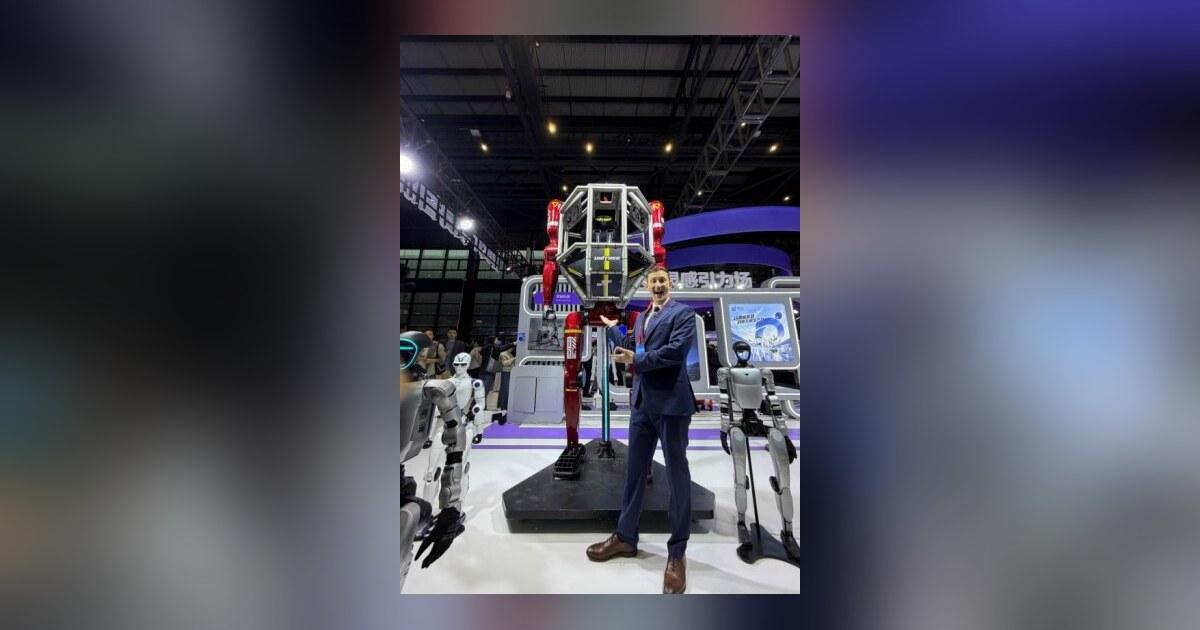
The recent World Internet Conference Wuzhen Summit, which concluded on Nov 5 in the canal town of Wuzhen in eastern China, showcased a striking evolution in robotics: machines that once danced for audiences are now being designed for critical, real-world tasks. Companies such as Unitree Robotics, AgiBot and UBTECH used the "Light of Internet" Expo to demonstrate how far robots have come, but the deeper significance lies in their transition from exhibition halls to emergency response, industrial operations and urban management.
Evan Kail, an American content creator visiting the expo, paused in front of Unitree Robotics' GD01, a robot designed for emergency-response scenarios. He noted that just a few years ago, Unitree robots were widely known for dancing in televised gala performances. Now, machines like the GD01 point to more practical roles, including disaster response and search-and-rescue operations. "The leaps of technology in China are very impressive," Kail said. "As climate change gets worse and worse, robots like this can make a difference if they are used to save lives."
This shift from eye-catching demonstrations to practical deployment was a recurring theme across the expo. But for robots to work reliably in crowded streets, disaster zones or industrial sites, the machine itself is only part of the equation. It also needs a network capable of carrying huge amounts of data, responding almost instantly and supporting AI decisions close to where they are needed. At China Mobile's booth, a display highlighted traffic-management robots deployed in Hangzhou, which earlier this year placed 15 robots at major intersections during a peak holiday travel period. Part of the Hangzhou Police Smart Mobility program, these robots answer questions, guide pedestrians and vehicles, and warn about traffic violations.
The deployment illustrates how connectivity is becoming central to the usefulness of intelligent machines. The current system uses 5G and 5G-Advanced connections and typically supports one camera on each robot. Future versions are expected to carry as many as six cameras and operate more independently within defined areas. That will require latency below 10 milliseconds, uplink speeds above 100 Mbps and positioning accurate to within centimeters — demands that are helping shape the development of 6G. The next generation of mobile technology is still years from commercial deployment, but its ambitions extend beyond faster download speeds. Industry plans for 6G include combining communications with sensing, edge computing and satellite connectivity.
"With 6G, networks will effectively gain radar-like eyes — the ability to sense and understand their surroundings — while AI will give them a brain," said Liang Zeshuai, a network optimization engineer at China Mobile Zhejiang. In this vision, a base station would do more than transmit data. Equipped with radar-like sensing capabilities, it could detect a nearby drone, identify obstacles around a blind corner or provide an autonomous machine with a more detailed understanding of its surroundings. Edge computing, meanwhile, would allow AI tasks to be processed closer to the user, rather than sending every request to a distant data center. That could matter especially in complex and dangerous environments where time, connectivity and situational awareness can make a difference.
Satellite connectivity could provide another layer of resilience when typhoons, earthquakes or other disasters damage ground-based infrastructure. China Mobile has launched a direct-to-handset service using the Tiantong and BeiDou satellite systems. For now, 5G-Advanced has already been widely rolled out across China. In Wuzhen, a 5G-Advanced "super uplink" network with upload speeds of up to 1,000 Mbps covered the conference venue for the first time. Robot dogs used the network to patrol the area, transmitting 4K video and location data in real time.
The same combination of connectivity, computing and AI is moving into industries where the gains may be less visible than a dancing robot, but potentially more consequential. China Mobile and Sinopharm, China's state-owned pharmaceutical and healthcare conglomerate, have developed an AI-enabled cold-chain logistics platform that has reduced delivery costs by 65% and cut delivery times by 70%. At Ningbo-Zhoushan Port, China Mobile has built what it describes as the world's largest 5G private network for port operations, supporting real-time coordination among cranes, vehicles, cameras and control systems. The company is also applying AI and connected systems to public safety and emergency management, including flood-control planning and drone inspections of buildings. The aim is not only to respond faster after an emergency, but to identify risks before they become crises.
At Wuzhen, the robots remained the most visible attraction. They made coffee, danced for visitors and posed for cameras. Yet the more consequential story was happening behind them — in the networks, computing systems and satellite links that could determine how quickly AI moves from a trade-show novelty into a tool for cities, industries and, potentially, lifesaving work. As reported by Media OutReach Newswire, the summit underscored that the future of robotics depends as much on invisible infrastructure as on the machines themselves.