
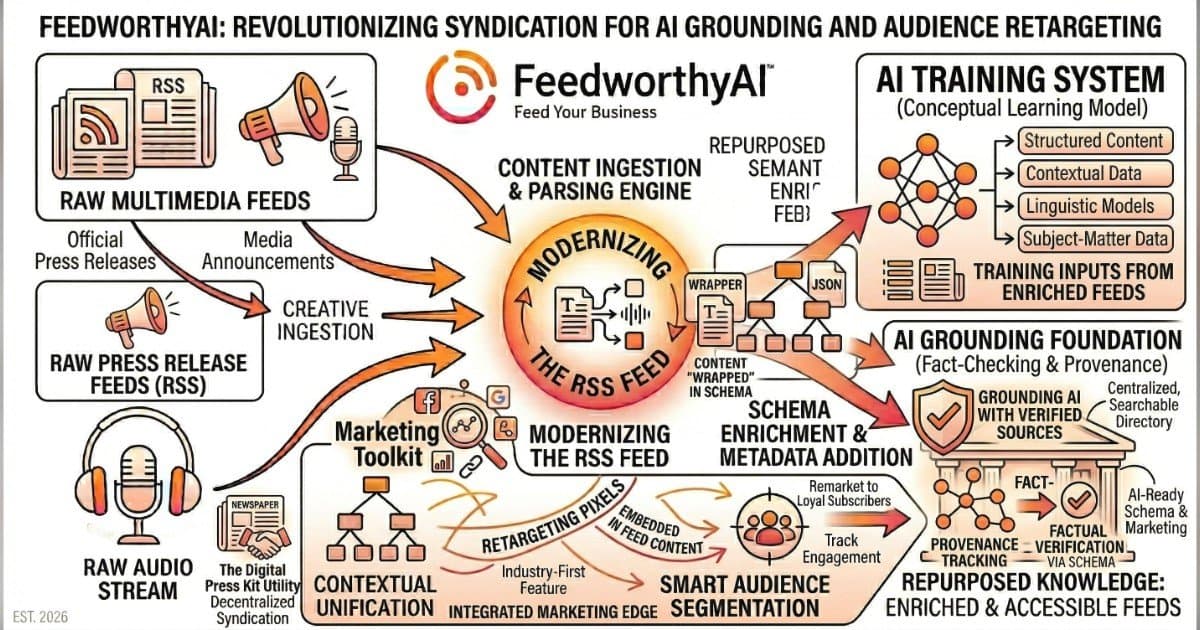
The launch of FeedworthyAI represents a significant development for digital content creators seeking to navigate the challenges of AI-driven discovery and distribution. In an environment where content visibility is increasingly governed by opaque algorithms, this platform provides tools to make traditional RSS feeds compatible with modern generative AI systems. By offering a centralized directory and schema application tools, FeedworthyAI addresses a critical need for publishers who want their work to be properly indexed and cited by AI models.
Industry experts have highlighted the platform's potential to bridge the gap between traditional syndication methods and contemporary content discovery. Justin McKenzie, host of the Building Texas Show podcast, noted that the tool helps creators overcome the challenge of reaching audiences in a crowded digital market. The platform's timing coincides with a broader resurgence of RSS technology, which offers a decentralized alternative to algorithm-controlled social media feeds that many users and publishers find limiting.
FeedworthyAI's technical approach centers on two key innovations that enhance the commercial and functional value of RSS feeds. First, the platform allows publishers to apply structured schema to their content, providing AI systems with clear metadata about what the content contains and why it represents a reliable source. This structured data is essential for applications like AI Training and AI Grounding, where AI models need accurate information for fact-checking and real-time retrieval. Second, FeedworthyAI introduces integrated retargeting capabilities, enabling publishers to embed tracking pixels directly within their RSS feed content.
The retargeting feature represents a notable advancement for content monetization and audience engagement. By supporting pixels from seven major advertising and analytics services, including industry leaders like Google Ads, Meta, and X, the platform allows creators to track engagement across platforms and implement sophisticated retargeting campaigns. This transforms passive RSS consumption into an active lead-generation channel, giving publishers valuable data about their most dedicated subscribers.
FeedworthyAI operates through a dual-system approach that serves both discovery and optimization needs. Publishers can submit their feeds to a global directory that makes content searchable for AI aggregators, researchers, and specialized audiences. Simultaneously, the platform automatically enhances these feeds with structured data while providing interfaces for managing tracking and analytics. By offering these services free of charge, FeedworthyAI aims to level the playing field between independent creators and larger media organizations in the increasingly important realm of AI content discovery.
The implications of this launch extend beyond technical functionality to broader questions about web architecture and content distribution. As generative AI becomes more integrated into information retrieval systems, tools that ensure accurate content understanding and proper attribution will grow increasingly vital. FeedworthyAI's approach supports the movement toward a more structured, open web where publishers maintain greater control over how their content is distributed and interpreted by both human audiences and artificial intelligence systems.