
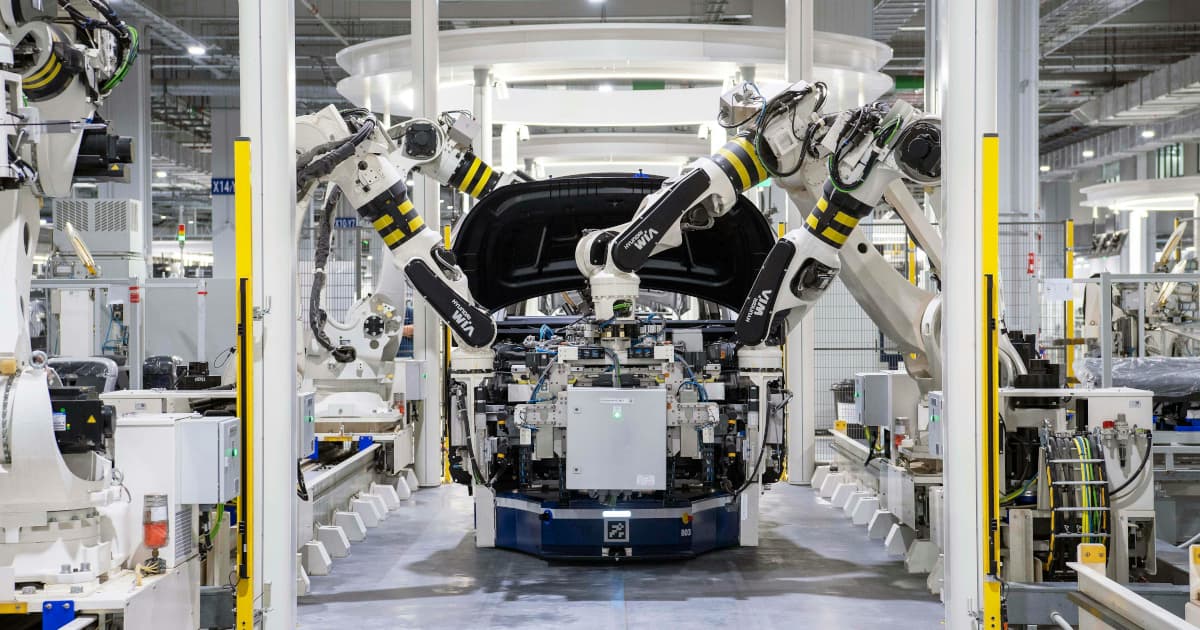
Conversations about artificial intelligence tend to center on models, semiconductors and server farms. Before any of those processors can do useful work, though, each one has to be packaged, checked for defects and turned out at scale, and all of that takes place inside manufacturing plants. TrendForce estimates that capital spending by the nine biggest cloud companies is projected to reach roughly $830 billion in 2026. Whether those dollars become functioning hardware hinges on the automated production and inspection tools that support the buildout.
Operating as TechForce Robotics, Nightfood Holdings Inc. (OTCQB: NGTFD) (profile) is pushing into this link of the production chain. Through a recent deal, the company took ownership of a defined set of CoWoS automated optical inspection technology, and a production site of 20,000 square feet is being planned for Taiwan. First deliveries are slated for late November or early December 2026, though timing will depend on whether production is ready and on orders coming in from customers.
The strategic significance lies in the timing. CoWoS, or Chip-on-Wafer-on-Substrate, is an advanced packaging process that allows high-bandwidth memory to be stacked alongside logic dies, a prerequisite for the GPUs and accelerators that power AI workloads. As hyperscalers pour capital into data centers, the ability to inspect these packages at volume becomes a gating factor. Any bottleneck in packaging or inspection can delay the deployment of entire compute clusters, making the segment disproportionately important relative to its share of total capital expenditure.
Nightfood is working to be recognized as a source of innovation across the wider AI and automation landscape, alongside established names such as KLA Corporation (NASDAQ: KLAC), Onto Innovation Inc. (NYSE: ONTO), Applied Optoelectronics Inc. (NASDAQ: AAOI) and… Read More>>
The announcement matters because it signals that smaller players are attempting to carve out positions in a supply chain dominated by large incumbents. If the Taiwan facility begins shipping on schedule, it would provide an additional source of inspection capacity at a time when demand is outstripping supply. Conversely, delays would underscore how difficult it is to scale specialized equipment quickly. Either outcome will be watched closely by investors assessing whether the AI buildout can proceed at the pace implied by the capex figures.
For market participants, the development also serves as a reminder that the AI trade extends beyond chip designers and cloud providers. The less visible layers, including packaging, test and inspection, may determine how quickly capital spending translates into revenue-generating compute. As AINewsWire Editorial Coverage notes, the production chain is where the AI boom either holds together or frays.
Disclosure and disclaimer information is available via the https://www.AINewsWire.com/Disclaimer page.