For years, businesses have been told to assemble their software stack by selecting the best tool for each function and connecting them through integrations. But according to idhubs, that approach is fundamentally flawed, especially as artificial intelligence becomes capable of executing complex, multi-step workflows.
In a recent interview on The Building Texas Show, Justin Mackenzie spoke with idhubs Founder and CEO/CTO Rojit Sorokhaibam and Chief Growth Officer Brandon Fears about why the integration model breaks under AI and how their platform aims to replace the traditional software stack.
Brandon Fears described the chaos that fragmented software creates for a typical business under 200 employees, which runs about 42 separate applications. A simple task like converting a prospect and billing a deposit can touch five different apps, requiring multiple logins and manual data transfers. "Most of the day goes to running software instead of running the business," Fears said.
Rojit Sorokhaibam added that these systems often disagree with each other, with data in one being a slightly different version of data in the next. "For ten years the industry sold that gap as a feature and called it 'best of breed,'" he noted. But with AI evolving into an agent that executes work, siloed data becomes a wall. "An agent cannot intelligently complete a workflow if it has to reach across five databases that only pretend to talk through brittle webhooks," Sorokhaibam explained. He calls this "context blindness" and argues that true intelligence requires one data foundation that cannot be bolted on after the fact.
Fears distilled the distinction: "Integrated means two databases that learned to talk. Native means there was only ever one."
To illustrate the power of native unification, Sorokhaibam outlined a customer success workflow. In a fragmented stack, a complaint on a community forum would require a support agent to manually read it, open the CRM, check billing, and draft a reply. In idhubs, an AI agent natively reads the post, pulls the user's billing history from the unified invoicing module, identifies a double-charge, auto-drafts a credit memo, and routes it for approval—all without human copying and pasting. "It executes the workflow because it has the context," Sorokhaibam said.
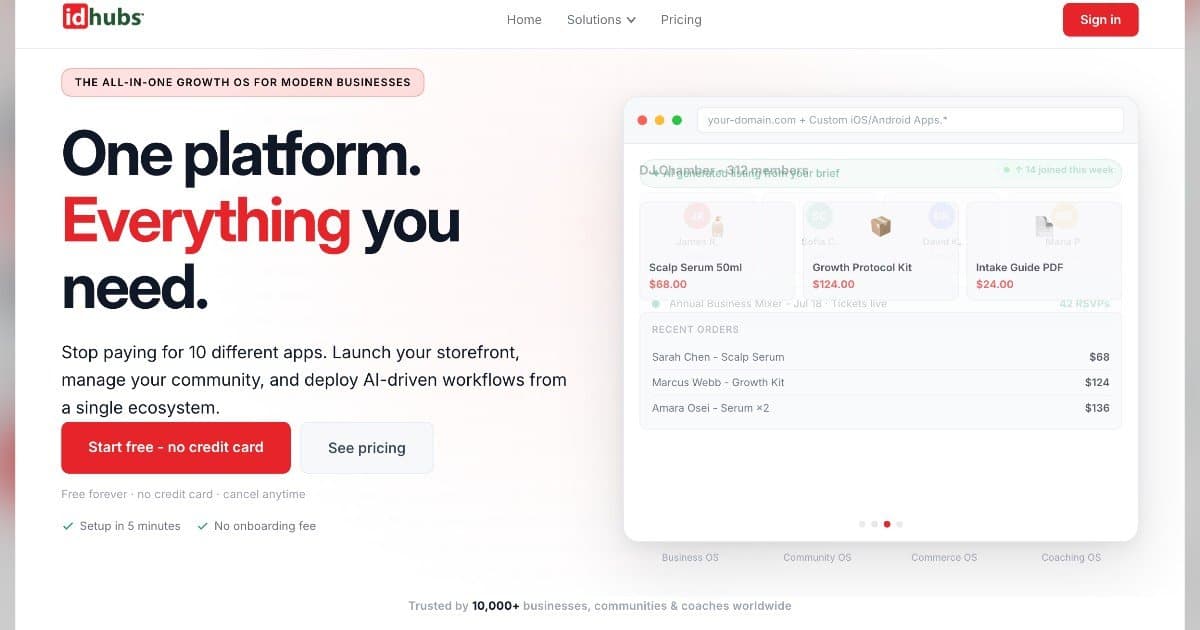
idhubs offers a natively unified operating system that includes CRM, e-commerce, community, invoicing, and AI on a single shared data layer. "We're not another tool for the stack. We replace the stack," Sorokhaibam stated.
The platform also includes a white-label community and social commerce layer. Fears explained that because the front office and back office share the same database, organizations get a branded private ecosystem where community discussions can become transactions or support tickets without leaving the environment. "When you build your community on a third-party social platform, you rent your audience; you don't own the data, you don't control the algorithm and you can't monetize without a cut taken off the top," Fears said. With idhubs, the organization owns the relationship and the data, creating a closed loop.
Addressing concerns about a single point of failure, Sorokhaibam revealed that idhubs runs a permissioned, private Hyperledger Fabric network underneath the platform. Unlike public blockchains, Fabric uses channels and private data collections, so sensitive records are visible only to cryptographically authorized nodes. This provides decentralization and immutability within the organization's walls, neutralizing the single-point-of-failure risk of monolithic software.
Sorokhaibam also dismissed fears about resource intensity, noting that Hyperledger Fabric is built for enterprise performance. Heavy payloads are stored off-chain, while the ledger only anchors state changes and audit trails. "It runs asynchronously in the background. It doesn't slow down the user interface or query speeds, but it gives you military-grade auditability and data sovereignty without the enterprise infrastructure bill," he said.
The company reports that it is a live, revenue-generating platform with a total addressable market of roughly $158 billion. It has acquired more than 50,000 registered users organically, with no paid marketing spend. The leadership team includes Sorokhaibam, a three-time exited CTO; Fears, who has launched over $2 billion in products; and COO Sav, a 30-year operations leader. Its advisory board includes Grant Johnson, former CEO of a NASDAQ-listed company, and Craig Kaufman of Kaufman Bros.
On pricing, Fears said idhubs killed per-seat pricing because it punishes companies for scaling their teams. Instead, pricing scales with organizational capacity and transactional volume, with a flat, predictable annual rate and transparent tiered bumps. "You know exactly what your software bill will be in Q4, regardless of whether you hired five people or fifty," he said.
When asked about skeptics who prefer best-of-breed point solutions, Fears argued that the flexibility is a "fragmentation tax in a nicer outfit." He said a five-person company ends up paying for multiple tools and still has data that doesn't agree. "The opposite of a bad stack isn't a better stack; it's one platform, one login, one source of truth," he said.
Sorokhaibam addressed the concern that unified modules might be less deep than specialized tools. He said idhubs builds deep, API-first modules, such as financials with multi-currency and automated tax compliance. For niche workflows, customers can build custom extensions on top of the unified data layer. "They get the depth of a custom build with the unified context of an OS," he said.
Migration is often the biggest barrier to switching, but Fears said idhubs engineered it out. The company built automated migration pipelines for major incumbents like HubSpot, QuickBooks, Salesforce, and Slack. It runs parallel environments and maps data schemas automatically, measuring time-to-value in days, not quarters. The user interface is designed to feel familiar, minimizing habit change.
Finally, regarding competition from legacy suites like Zoho, Odoo, and HubSpot, Sorokhaibam argued that those were built as separate apps glued together later, so their data layers remain fragmented. "We are natively unified from the ground up on a single data layer," he said, adding that idhubs' Hyperledger security model is enterprise-grade out of the box, which legacy SMB suites lack. "They are a suite of tools trying to act like an OS. We are a single, secure operating system. The skeptics are fighting the last war. In the AI era, context is the whole game."
If this model wins, Sorokhaibam believes software becomes a silent partner, eliminating the integration tax and allowing human capital to focus on strategy instead of reconciliation. For member organizations, it turns a siloed directory into a connected economic ecosystem. Fears added, "Owners didn't choose complexity; the market handed it to them one app at a time. Every vendor promises the next app will fix it. But the next app can't fix it, because the app was the problem. The fix was never one more tool or one more integration. It was always one secure, unified platform. That's what we built and that's why the shift is inevitable."
idhubs is headquartered in McKinney, Texas.