
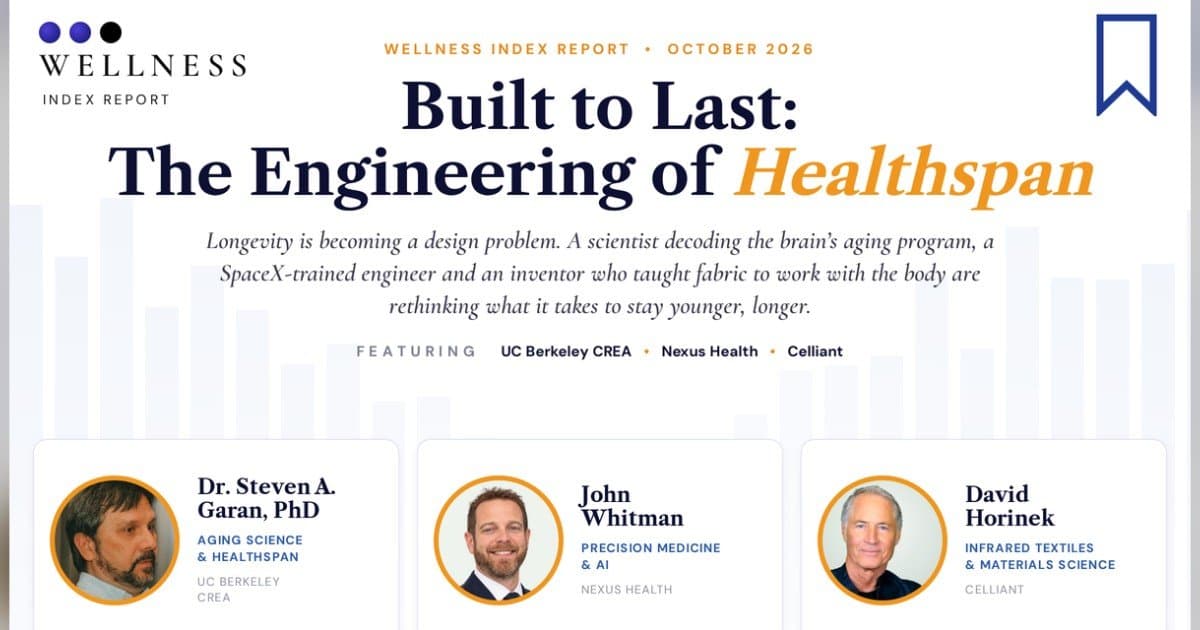
The October 2026 Wellness Index Report, titled 'Built to Last: The Engineering of Healthspan,' released by Wellness Eternal, argues that the pursuit of a longer, healthier life is shifting from passive hope to active design. The report, published the same month as World Menopause Day on October 18, examines whether aging occurs in distinct phases and how individuals and clinicians might proactively plan for future life stages.
Central to the report are three experts featured on The Wellness Index Report Podcast, each addressing a different facet of the aging process. Dr. Steven A. Garan, director of bioinformatics at the Center for Research & Education on Aging (CREA) at UC Berkeley, contends that aging is a program driven by the brain—specifically the hypothalamus, which he describes as the master clock for milestones from adolescence to menopause—rather than simple wear and tear. His profile is available on the Dr. Garan page.
John Whitman, co-founder and chief innovation officer of Nexus Health, brings a precision-medicine and artificial-intelligence perspective. Having spent over a decade building failure-critical systems, including as a principal systems engineer at SpaceX, Whitman now leads a platform that integrates DNA, lab results, and intake data so clinicians can see connections across the body. Every finding includes its reasoning, and nothing reaches a patient without clinician review; the platform is HIPAA compliant and SOC 2 Type 2, with zero data mining. His work exemplifies the report's second trend: AI that connects the dots with explainable results and the clinician in control. More details are available on the Whitman profile.
David Horinek, inventor of Celliant and co-founder of Hologenix, represents the third trend: wellness woven into everyday life. Celliant, a mineral-infused textile technology, captures the body's own heat and returns it as infrared energy. The idea began in the 1990s when Horinek sought to support his grandmother's mobility, and today Celliant is embedded in apparel, bedding, and recovery products from brands worldwide. His podcast conversation is set to air in November, and his background is detailed on the Horinek page.
The report identifies three signals shaping healthspan: aging as a brain-driven program rather than mere deterioration, with research focusing on midlife and menopause acceleration; AI that reasons across genetics, labs, and history while keeping clinicians in control; and consumer adoption of products that work quietly in the background. These trends matter because they suggest a future where longevity is not left to chance but is engineered through targeted interventions, transparent AI, and passive wellness technologies. The full October 2026 Wellness Index Report is available at https://www.wellnessindexreport.com/indexreports/wellness-index-report-october-2026.