
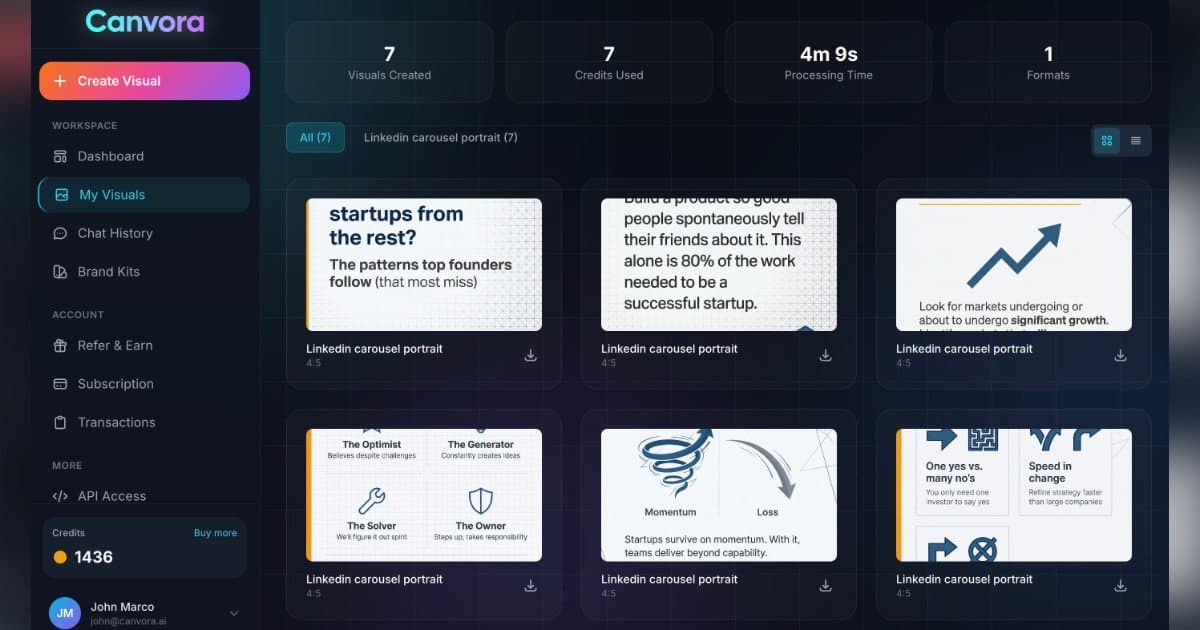
Canvora, an AI design platform, has announced that its visual generation engine is now available directly inside Claude and ChatGPT. Using the Model Context Protocol (MCP), users can create finished, on-brand marketing visuals in the same conversation where they plan their content, eliminating the need for separate design tools, templates, or manual layout work. This integration matters because it addresses a critical gap in AI-assisted workflows: while AI assistants have become a daily workspace for marketers, founders, and small teams, they have primarily generated text, not finished visuals. Turning an idea into a polished social post or carousel still required switching to a separate design tool. Canvora closes that gap by allowing users to describe what they want—or paste a URL or document—and receive platform-ready visuals matched to their brand's colors, fonts, and tone.
The implications for productivity and creativity are significant. Through the integration, users can generate social posts, multi-slide carousels, infographics, ads, and presentations across more than 100 formats, then edit, restyle, localize, or export them as PDF, PowerPoint, or images—all from within the chat. This streamlines the content creation process, reducing the friction that often slows down marketing teams. Because Canvora connects through the open Model Context Protocol, the same integration works not only in Claude and ChatGPT but in any MCP-compatible AI agent. A REST API, included on every plan, lets developers embed Canvora's visual generation directly into their own agents, apps, and automations. Details for developers and agent builders are available at canvora.ai/for-agents. The result is a visual layer for the broader agent ecosystem, not just a single-app plugin.
Canvora's most distinctive capability is multilingual design. The platform supports content generation in more than 150 languages, including right-to-left scripts such as Arabic and Hebrew. Rather than translating text and breaking the layout, Canvora localizes each visual in place—preserving the original design while swapping only the language. A single campaign can become Spanish, French, Arabic, and German versions in one step, a workflow that typically consumes hours of manual redesign. This feature could be a game-changer for global businesses seeking to maintain brand consistency across markets without incurring heavy design costs.
"AI assistants are where people now start their work, but they stop at text," said Vivek Sethi, founder of Canvora. "We built Canvora to be the visual layer for that workflow—so anyone, or any agent, can go from an idea to an on-brand, publish-ready design, in any language, without leaving the conversation." The integration works today on all Canvora plans, including the free tier, and connects in one step using OAuth—no API keys or manual configuration required. Canvora is available at canvora.ai and can be added as a connector in Claude, ChatGPT, and any MCP-compatible agent. By embedding visual creation into the tools where work already happens, Canvora is positioning itself at the center of a shift toward more integrated, AI-driven content workflows, potentially reducing the need for specialized design software for everyday marketing tasks.